

Tea in Anime

There’s a lot of people that watch anime from all around the world and in South Africa too, but there are those who view it as entertainment for kids especially in South Africa, more so amongst black South Africans, ba reng ke dipopaye and those people mostly “older millennials and boomers” will most probably never appreciate the storytelling, the life lessons and art that goes into anime, to them anime is something you stop watching when you reach a certain age. But I am not those people and nna I love that shit, maybe not enough to dress up as Naruto, Kakashi sensei, Goku or Aang, but I will binge watch a good anime series and not feel like I was just watching kiddies entertainment.
I recently posted a note reflecting on how growing up Kung Fu movies were my introduction to Chinese culture, a sort of “gateway drug” to all the things I love about China and Chinese culture today, from martial arts, the traditionally inspired fashion, the ancient architecture, I wondered how an eggroll tasted and wanted to eat using chopsticks and my current obsession with Chinese tea. Anime in many ways introduced me to Japan and gave me a growing fascination for Japanese culture, I wondered how Naruto’s favourite food (Ramen) tasted, I was intrigued by the fashion/gear the shinobis wore, I wanted to dress like a ninja and kick ass like one too, watching Karate Kid and Three Ninja Kids definitely sparked my curiosity with Japanese martial arts and the culture.
I first noticed tea in anime while watching The Last Airbender I noticed how much Uncle Iroh loved tea and that made me wonder why he loved it so much, back then I didn’t know as much as I know about tea or anime for that matter, but I know now that tea is not just “hot leaf juice” and that technically The Last Airbender is not an anime. It is an American animated series created in the tradition of anime, inspired by East Asian art forms, philosophies, and storytelling conventions so deeply that this distinction feels almost academic.
For the purposes of this conversation, which is really about tea philosophy disguised as animation, Uncle Iroh certainly belongs and deserves an honourable mention, for making me notice something that many probably miss unless of course they are obsessed with tea like me, which means it’s something they hardly ever miss, tea becomes something you see almost immediately in any scene, sometimes before you see any other details in the scene.
Of all the tea lovers in animation, none has taught the world more about tea than a fictional retired general from the Fire Nation who carries a battered teapot wherever he goes and will, under almost any circumstances, stop what he is doing to brew someone a cup. What makes Iroh unforgettable isn’t that he drinks tea all the time. It’s why. Tea is never merely tea for Iroh, it is not just “hot leaf juice”. Every cup carries memory. Every pot carries forgiveness.
Every shared brew is another opportunity to reach someone in a manner that words alone cannot touch. He drinks tea to remember the son he lost. To make peace with the man he used to be. To quietly remind himself, and everyone around him, that there is still goodness worth protecting in the world. He is, in the truest sense, a practitioner of ichi-go ichi-e - the Japanese tea principle that each encounter is singular, unrepeatable, and therefore sacred. Iroh never makes tea casually. He makes tea deliberately, for whoever is in front of him, as if this particular cup, shared with this particular person, in this particular moment of grief or rage or confusion, is the most important cup he has ever prepared.
And it usually is.
What Iroh understands and what the series effectively communicates with remarkable elegance is that tea is not a solution. It is an invitation. An invitation to slow down long enough to be reached. You cannot force a conversation with someone who is in pain. But you can put a warm cup in their hands and sit across from them without demand. You can let the ritual of patient preparation, the attentive boiling of the water, the careful steeping and the precise pouring, create a small pocket of time in which something true might be said.
Tea cannot undo pain. Tea cannot fix what is broken.
Tea can only create the space to sit with both.
Iroh never needed a formal tea house to practise this. His wisdom travelled in that battered teapot, shared freely with strangers, enemies, and most importantly with a nephew who had lost himself entirely. He did not quote Sen no Rikyu. He did not perform the chanoyu with prescribed movements and ceremonial garments. He simply made tea. For whoever needed it. With complete attention and without condition.
That, it turns out, is the ceremony.
In a world obsessed with speed, productivity, and spectacle, Uncle Iroh remains one of animation’s most radical characters and his radicalness is not because of what he does, but because of what he refuses to stop doing. No matter what is happening around him, no matter the scale of the conflict or the urgency of the politics pressing down on every scene, Iroh insists on pausing. On brewing some tea and offering it with both hands.
He understood what every great tea master eventually discovers.
The finest cup you will ever make has very little to do with the leaves, the precision of the pour or the perfection of the tea ware. It has everything to do with the person sitting across from you.
The idea to write this article came to me while watching The Eminence in Shadow where once again I saw many tea scenes and I started thinking about all the other anime I had seen tea scenes in and wondered how long tea has been part of our much loved anime movies and series as well as what role tea plays in each one, I thought it made sense to have tea in anime since tea is a big part of everyday life in Japan and Japanese culture for centuries and because anime originates from Japan, so it goes without saying that you will find tea in it, albeit it has a very subtle presence in most anime and one that you can’t miss in others. In this article we will explore the many ways tea has appeared in anime and what it means when tea is introduced into these different stories.
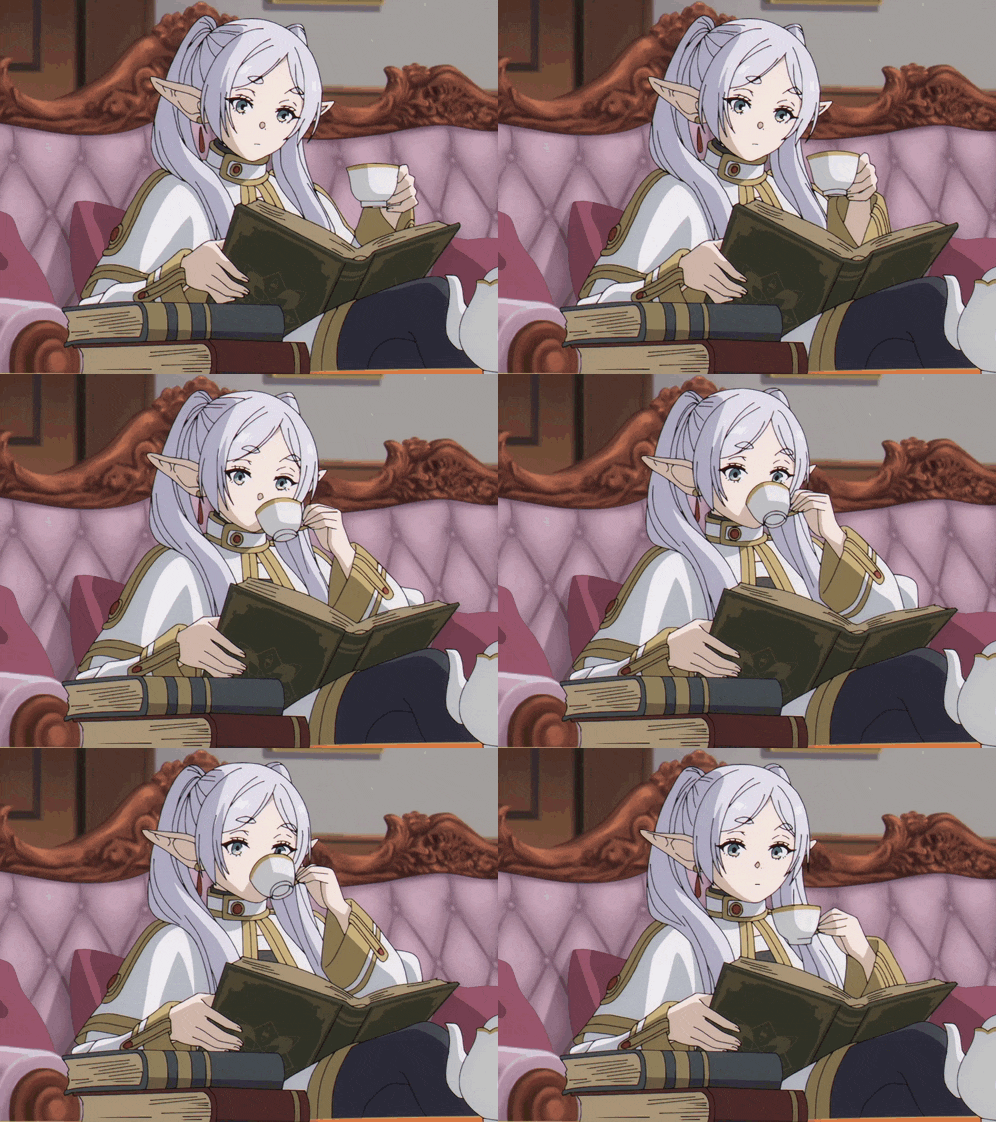
The Cup Behind the Frame: How Tea Quietly Brewed the Soul of Anime
I have been studying tea for some years now. I have travelled to China, walked through museums dedicated to preserving its history, sat in tea rooms where the silence was so deliberate it felt choreographed. I thought I understood where tea lived. Then I started watching anime with different eyes.
And I realised that some of the world’s greatest storytellers have been teaching tea philosophy for decades to the hundreds of millions of people who love anime, without ever once announcing it. Not through lectures. Not through tea ceremonies. Through animation.
Before Anime Learned to Move, Japan Had Already Learned to Pause
There is a reason tea appears so often in anime. Not because Japanese people drink tea. Everyone knows that. The more interesting question is why, in a medium famous for giant robots, supernatural spirits, impossible battles and worlds that exist only in imagination, creators repeatedly pause everything, just to let someone make tea. It happens so often that we almost stop noticing it. Someone boils water. A kettle whistles. Steam rises. The camera lingers. Nobody speaks. Then life resumes.
That pause is never merely accidental.
Japanese animation officially began in 1917, when pioneers Ōten Shimokawa, Jun’ichi Kōuchi, and Seitaro Kitayama experimented with short animated films inspired by Japanese folklore and Western animation. These early films were technically impressive for their time, but anime had not yet found its own identity.
Japan itself, however, already had.
Centuries before the first animated frame was ever drawn, tea had become woven into Japanese culture through chanoyu which is the Japanese tea ceremony refined by the great tea master Sen no Rikyū during the sixteenth century. Tea ceremony was never simply about drinking tea. It was about slowing down enough to notice life. Every movement mattered. Every sound mattered. Every season mattered. Every guest mattered. It embraced the philosophy of wabi-sabi: finding beauty in imperfection, simplicity, and impermanence. Looking back now, it almost feels inevitable that these ideas would eventually find their way into animation.
Because anime, at its best, does not simply tell stories. It teaches us how to look.
The Man Who Invented Modern Anime — And Accidentally Cursed It
Every discipline has its founding figure. For tea, many point towards Lu Yu or Lu Ji, courtesy name Jici was a Chinese tea master and writer. Who is respected as the Sage of Tea for his contribution to Chinese tea culture, he is an 8th-century scholar whose Classic of Tea book, codified everything the Tang Dynasty knew about the tea leaf. For anime, there is little debate. That title belongs to Osamu Tezuka, affectionately and accurately known as the God of Manga.
When Tezuka founded Mushi Production in 1961, few could have imagined that a small animation studio would reshape global popular culture. Two years later, Astro Boy debuted on Japanese television, became Japan’s first successful weekly animated series, and effectively created the business model that still defines anime today.
Ironically, Tezuka also accidentally created one of anime’s greatest problems.
To convince television executives that animation could work on weekly schedules, he accepted impossibly low production budgets. Animators worked extraordinary hours for very little money. More than sixty years later, much of the anime industry still wrestles with what many call “Tezuka’s Curse” speaking to a structural exploitation of creative labour so normalised it has become almost invisible. Yet despite the industry’s relentless pace, something fascinating survived.
Anime never lost its ability to slow down. It never forgot the value of silence.
Tea people will recognise this instinctively. There is a particular discipline required to protect stillness inside a system designed for speed. The tea ceremony survived industrialisation, modernisation, and the complete reordering of Japanese society. Anime’s quiet moments survived Tezuka’s Curse. Both, it turns out, are more durable than the forces trying to eliminate them.
Tea Lovers Behind the Drawing Board
Before we go further, I’d like to share something about the most popular anime in South Africa and quite possibly the whole world Dragon Ball, that will make you look at it differently for the rest of your life.
Of all the great manga creators, Akira Toriyama may have left the clearest trail for tea lovers. In one of his published question-and-answer sessions, Toriyama openly admitted that his favourite teas were Oolong and Pu-erh, these are two of China’s most celebrated dark teas, one roasted and complex, the other fermented, aged and earthy.
Suddenly Dragon Ball begins revealing jokes hidden in plain sight.
The character Oolong is named after the tea. So is Puar, the gentle blue shapeshifter who accompanies Yamcha, whose name references Pu-erh. For decades, millions of fans around the world repeated those names without ever realising they were speaking the language of tea. Children across South Africa, across the continent, across the world, called out those names in schoolyards without knowing they were quoting a tea lover’s private taxonomy.
That discovery delighted me. Not because it changes Dragon Ball. But because it reminded me how deeply tea quietly sits inside East Asian storytelling and it’s embedded so naturally that even the creator’s personal enthusiasms become part of the world he built.
The Detective Who Drinks Tea Like a Religion
Before we get to the tea masters, we should talk about the tea drinker who was never trying to be one.


L Lawliet, the eccentric, sleep-deprived world’s greatest detective at the centre of Death Note, is one of the most recognisable figures in anime. You know the posture: knees drawn up to his chest, bare feet on the chair, dark-rimmed eyes staring at something no one else can see. He is almost never without two things: something obscenely sweet, and a cup of tea.
The sweets get most of the attention. The tea deserves more.
There is also a delicious irony hiding in plain sight. His name is L, and tea contains L-theanine, one of the compounds most responsible for tea’s unique effect on the mind. Unlike coffee, whose caffeine often arrives like a sprint, tea’s combination of caffeine and L-theanine promotes a state of calm alertness, improving focus, sustained attention and cognitive performance without the same sharp spikes or crashes. Whether the creators intended the connection or not, it feels almost too perfect. The greatest detective in anime just happens to live on the one drink whose chemistry is famous for helping people think more clearly.
L is explicit about it. He states, with the particular directness of someone who long ago stopped performing social norms, that he cannot think properly without sugar. His tea is always sweet. Heavily sweetened. Almost weaponised with sugar cubes dropped in with the methodical precision of someone adding variables to an equation. Me, myself I don’t like sugar in my tea, I prefer it without any sweetner, I was recently asked if I am a purist and the answer is a strong yes, most especially when it comes to my tea. But in the case detective L Lawliet uses the tea as a mode of sugar delivery. It is infrastructure. Without it, he claims, his deductive capacity drops by forty percent.
Whether or not we take that figure literally, and with L it is never entirely clear where performance ends and sincerity begins, the relationship between the detective and his tea reveals something worth sitting with. L does not drink tea for comfort. He does not drink it for ritual, or connection, or the pleasure of a slow morning. He drinks it because his mind is a machine that runs at a particular temperature, and tea is what keeps it there.
This is tea stripped of its ceremony. Tea as pure function.
And yet, and this is what makes L interesting rather than simply eccentric, there is something deeply attentive in how he prepares and holds his cup. He cradles it with his fingertips. He does not gulp. He does not ignore it. Even in the middle of a case that is consuming his entire existence, even when he is three moves ahead of everyone in the room and operating on almost no sleep, he pauses for the tea. The briefest pause. But a pause nonetheless.
For a character defined by his relentless forward motion, the inability to rest, the compulsive need to solve, the way he treats every human interaction as a puzzle to be decoded, that pause is significant. It is the only moment in which L is not entirely elsewhere. The tea brings him back to his body, if only briefly, if only to refuel.
There is a tea philosophy hiding inside that habit, even if L would find the observation irritating.
The Japanese tea ceremony was built on the understanding that the preparation and consumption of tea is itself a practice of mindfulness, that the act of stopping, attending and being present with a cup is inseparable from the quality of attention you bring to everything else. L would reject this framing entirely. He is not stopping to be present. He is stopping to recalibrate so he can disappear into thought again, more efficiently.
But the cup is still there. The pause is still real.
Death Note is, at its core, a story about two people trying to outwit each other across a chessboard the size of the world: Light Yagami, who wants to remake humanity, and L, who wants to catch him. Light is disciplined, controlled, physically perfect and rarely seen in a moment of genuine rest. L is chaotic, irregular, physically strange and always, always with his tea.
The tea does not make L sympathetic exactly. But it makes him human in a series that is otherwise almost entirely about the inhuman. It is the one concession he makes to ordinariness. The one ritual he keeps.
And in a story about gods, death and the corrupting weight of absolute power, one man crouching on a chair with a heavily sweetened cup of tea, thinking harder than anyone else in the room, is its own kind of quietly radical image.
Tea cannot give you genius. But L reminds us that even genius needs a ritual. It needs something to anchor the mind while it wanders into impossible places. Perhaps that’s the quiet brilliance of tea itself. It doesn’t do the thinking for us. It simply creates the conditions in which our best thinking can happen. And if that chemistry happens to include a little L-theanine, well... maybe L was always drinking exactly what his name suggested.
Studio Ghibli Didn’t Teach Us Tea. It Taught Us Tea Thinking.
People often ask whether Hayao Miyazaki loves tea. The better question is whether his films think like tea. I believe they do.
Watch almost any Studio Ghibli film. Someone prepares breakfast. Someone pours tea. Someone quietly watches rain collect on a window. Nobody rushes. Nothing explodes. The story simply breathes. Those scenes are not filler. They are philosophy.
In My Neighbour Totoro, steam rises from cups shared around a family table. In Howl’s Moving Castle, breakfast becomes ceremony. In Spirited Away, hospitality itself becomes sacred through food and tea. These moments embody ichi-go ichi-e — one meeting, one moment, never to happen exactly the same way again.
Tea teaches presence.
Studio Ghibli animates presence.
Perhaps that is why their films feel timeless. They refuse to hurry.
Anime’s Greatest Tea Master Isn’t a Tea Master
If you were to ask Hayao Miyazaki whether he considers himself a tea master, he would almost certainly laugh or more likely, frown, mutter something about the question being foolish, and return to his drawing board.
Miyazaki does not practise chanoyu. He has never formally studied the Japanese tea ceremony. He has never whisked a bowl of matcha with the precise, choreographed movements that define the art. And yet, across a career spanning six decades, no single creator has done more to translate the spiritual essence of tea culture into moving images.
Miyazaki is anime’s greatest tea master precisely because he never set out to be one.
The connection begins not with ritual, but with philosophy. The tea ceremony, as codified by Sen no Rikyū in the sixteenth century, is built on wabi-sabi: the appreciation of imperfection, impermanence, and the beauty of the humble and the incomplete. These are not decorative principles. They are ways of seeing the world. And they are the exact lens through which Miyazaki views his animated universes.
Consider the opening minutes of My Neighbour Totoro (1988). Two young girls arrive at a dilapidated country house with their father. The house is old, drafty, overrun with dust sprites. The garden is untamed. The well is moss-covered. Any conventional filmmaker would frame this as hardship. Miyazaki frames it as wonder. This is wabi-sabi in its purest form, the recognition that age, wear, and imperfection carry their own profound beauty. The tea ceremony teaches that a cracked bowl, repaired with gold, is more valuable than a perfect one because its history is visible. Miyazaki teaches that a crumbling house in the countryside is more magical than a palace because it has been loved.
His most explicit connection to tea culture appears in how he treats warmth. In My Neighbour Totoro, a father prepares a simple dinner of rice and vegetables for his daughters. The scene is unhurried. Steam rises from the pot. The light from an oil lamp flickers on wooden walls. The girls’ faces soften with exhaustion and comfort. There is no consequential dialogue. The scene exists simply to show that these people are safe, together, and nourished. It lasts perhaps two minutes, but it contains the entire emotional thesis of the film: that love is expressed through care, and care is expressed through the preparation of something warm.
In Howl’s Moving Castle (2004), Sophie cooks breakfast for Howl, Calcifer, and Markl. Eggs sizzle. Bread is sliced. Tea is poured. The castle groans and shifts around them, a mechanical beast held together by magic and rust, but the kitchen is warm, stable, and human. Nothing plot-critical happens. And yet this scene is why audiences remember the film.
Miyazaki has spoken about his fascination with the texture of everyday life, the way in which he observes the world outside his window, the way light falls through leaves, the movement of insects, the sound of rain. This is the same practice that underlies the tea ceremony: the cultivation of ichigo ichie, the understanding that each moment is unique and unrepeatable, and therefore worthy of complete attention. A tea master does not simply drink tea. They enter a state of heightened awareness, noticing the temperature of the air, the sound of water boiling, the weight of the bowl.
Miyazaki’s films demand the same awareness from their viewers. You cannot watch a Ghibli film while scrolling through your phone. The pacing will not allow it. The films slow you down, force you to look, to listen, to be present.
This is the function of tea ceremony. Achieved through animation.
There is a deeper irony in calling Miyazaki a tea master, one that he himself would appreciate. The tea ceremony, in its modern form, can become rigid, performative, and class-bound, reduced to rules about how to hold a bowl, how to fold a cloth. Miyazaki’s work is the antithesis of this rigidity. His female protagonists Nausicaä, Kiki, San, Chihiroa and Sophie are not passive recipients of wisdom. They run, fly, fight, and transform. If the tea ceremony represents a particular ideal of Japanese femininity quiet, graceful, contained his heroines explode that ideal. And yet they share with the tea ceremony a profound respect for the interconnectedness of all things. Nausicaä’s communion with the Ohmu and Chihiro’s labour in the bathhouse, these are expressions of wa (harmony), one of the four principles of tea ceremony, achieved through action rather than stillness.
Perhaps the most compelling evidence of Miyazaki’s connection to tea culture is not in his films at all, but in his working methods. Miyazaki is famous for his gruelling schedule, his perfectionism, his refusal to compromise. He draws thousands of frames by hand. He has redrawn entire sequences because a single cloud did not look right. This is not the relaxed image of a man sipping tea in a garden. It is the discipline of a craftsman who understands that mastery is not a destination but a practice.
The tea ceremony is often misunderstood as a ritual of relaxation. In fact, it is a discipline of extreme concentration. Every movement is prescribed. Every gesture has meaning. The practitioner must be simultaneously aware of the self and the self’s dissolution into the moment. Miyazaki’s animation process mirrors this exactly. He does not draw to express himself. He draws to serve the film, to serve the audience, to capture something true about the world. The ego is subordinated to the work.
This is the same surrender that a tea master makes when entering the tea room.
Hayao Miyazaki will never sit in seiza and whisk matcha for a gathering of guests. But in his insistence on the beauty of the imperfect, his reverence for the natural world, his discipline of attention, and his ability to slow time until a single moment becomes luminous, he has done something more valuable than mastering a ritual. He has made the spirit of tea ceremony accessible to millions of people who will never enter a tea room.
He is anime’s greatest tea master because he understood that the ceremony is not in the bowl. It is in the seeing.
The Anime That Made Tea the Main Character
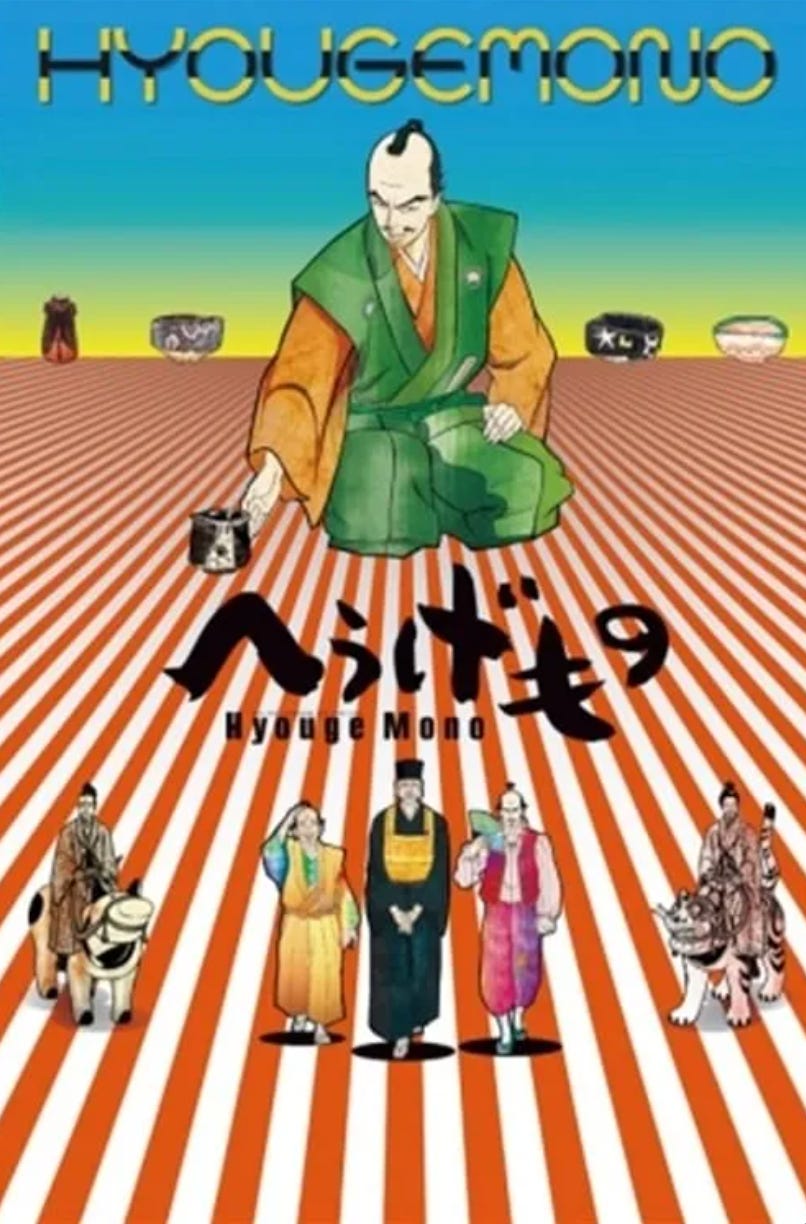
Almost nobody outside and even inside the tea world knows about Hyouge Mono. Which is exactly why I am going to spend some time here.
In a medium crowded with sword fights, magical transformations, and world-ending stakes, one anime dared to make its central obsession something far quieter, far more deliberate, and infinitely more divisive: a bowl of tea.
Hyouge Mono (へうげもの, 2011) is a historical drama that follows Furuta Sasuke, a samurai in Japan’s Warring States period who is less interested in battlefield glory than in the pursuit of aesthetic perfection through chanoyu. It is, by almost every commercial metric, a failure. It is also, for the right viewer, one of the most extraordinary works ever produced in the medium.
The series is set in the late sixteenth century, this is an era of constant civil war, political intrigue, and brutal power struggles. Sasuke serves under the warlord Oda Nobunaga, one of the three great unifiers of Japan. Historically, Sasuke was a real figure, a samurai who rose through the ranks and eventually became a student of Sen no Rikyū, the man who would revolutionise the tea ceremony and define its aesthetic philosophy for generations. The anime takes this historical foundation and builds a character study of a man torn between two worlds: the violent, pragmatic realm of the warrior, and the refined, spiritual domain of the tea master.
Sasuke is not a reluctant hero. He is a willing participant in the politics of his age, but his true passion is not conquest, it is beauty. Specifically, the beauty of a perfectly whisked bowl of matcha. The texture of a Raku tea bowl. The arrangement of flowers in an alcove. The series opens with Sasuke witnessing Nobunaga’s prized Lacquered-Ware Ewer and experiencing what can only be described as an aesthetic epiphany. From that moment, the viewer understands that this will not be a conventional samurai epic.
The battles that matter here are not fought with steel. They are fought with taste.
What makes Hyouge Mono remarkable is that tea is not background detail or character quirk. It is the entire narrative engine. Every episode revolves around some aspect of tea culture: the acquisition of a rare utensil, the politics of a tea gathering, the philosophical debates between Rikyū and his disciples, the tension between the ostentatious display of wealth favoured by Nobunaga and the austere simplicity of wabi-cha that Rikyū was refining into a form of spiritual resistance. The series is essentially a prolonged meditation on what it means to devote one’s life to an art form that appears, to the uninitiated, to be nothing more than drinking hot water and powdered leaves.
The tea ceremony scenes are rendered with extraordinary care. The animation, produced by Bee Train, is not flashy by contemporary standards, but it is precise. The movements of the hands, the rotation of the bowl, the sound of the whisk against ceramic, these are given the same visual weight that other anime reserve for a mecha transformation sequence or a final boss reveal. A single tea gathering might occupy ten minutes of screen time, with the camera lingering on steam rising from a bowl, on the grain of a wooden tea scoop, on the expression of a guest receiving tea.
This is not padding. It is the point.
At its core, Hyouge Mono is about wabi-sabi which is the Japanese aesthetic principle that finds profound beauty in imperfection, impermanence, and incompleteness. Rikyū’s tea ceremony was revolutionary because it rejected the opulence of earlier styles in favour of rustic simplicity: rough-textured Raku bowls, weathered bamboo scoops, flowers arranged as if casually gathered from a field. This philosophy was not merely decorative. It was deeply spiritual, rooted in Zen Buddhism, and it offered the warrior class a way to contemplate mortality and transience in a time of constant death.
Sasuke’s journey is the journey of a man learning to see. The series is filled with moments of genuine revelation, where Sasuke looks at a cracked tea bowl, a faded scroll, a single blossom, and understands something about existence that cannot be put into words. These moments are the emotional climax of the series, more affecting than any conventional action sequence could be. The show asks a radical question: what if the most important thing a person can do is learn to appreciate a bowl of tea?
What if that appreciation is, in fact, a form of courage?
Hyouge Mono aired for 39 episodes between April 2011 and September 2012. By modern standards, a substantial run. Yet it received almost no international distribution. No major streaming platform has picked it up for Western markets. Fan subtitles exist, but they are sparse and often incomplete. No action figures. No video game tie-ins. No cosplay presence at conventions. It is, by the standards of contemporary anime fandom, invisible.
The reasons are obvious. It is slow. It is historically dense, requiring at least passing familiarity with the Sengoku period and its major figures. It is visually restrained, with none of the kinetic energy or fantastical imagery that drives social media engagement. Its protagonist is not a teenager with superpowers but a middle-aged man with a receding hairline and an obsessive relationship with ceramics. The series does not offer easy emotional catharsis. It offers contemplation and contemplation is a hard sell.
But this obscurity is precisely what makes it valuable. In an era of algorithm-driven content, where every anime is designed to maximise engagement and merchandise potential, Hyouge Mono is a work of genuine artistic conviction. It was made because someone believed that the story of a man learning to make tea was worth telling, even if almost no one would watch it. That belief gives the series an integrity that is rare in any medium.
For those of us who love tea, it is a revelation. It is the only anime that treats tea ceremony not as a quaint cultural accessory but as a serious philosophical and artistic practice. It demonstrates, with historical specificity and emotional depth, why the tea ceremony mattered to the people who devoted their lives to it. It shows the political dimensions of tea, how a bowl of matcha could be a gesture of alliance, a display of power, or a quiet renunciation of worldly ambition. More than that, it captures the ethos of tea. The series understands that tea ceremony is not about the tea. It is about attention. It is about the discipline of being fully present in a moment that will never recur. It is about finding, in the simplest of human rituals, a connection to something larger than oneself.
In a landscape of cute characters drinking cute tea, Hyouge Mono is the adult in the room who’s demanding, difficult, and ultimately unforgettable.
Seek it out. Quietly. The way tea deserves to be found.
Sosuke Aizen: The Villain Who Would Bend Reality Before Giving Up His Tea
If Uncle Iroh shows us tea as compassion and L shows us tea as concentration, then Sosuke Aizen from Bleach reminds us that tea can also become theatre.


Long before fans discovered he had been orchestrating almost every major event in the Soul Society from behind the scenes, Aizen was rarely seen without the calm, composed demeanour of a gentleman. And somewhere within that image sat another constant. Tea.
It is officially Aizen’s favourite drink, which somehow feels entirely appropriate. Everything about Aizen is measured. Every word is calculated. Every movement deliberate. Even when the world around him descends into chaos, he carries himself with the kind of composure that feels almost impossible. Tea becomes an extension of that personality. It is difficult to imagine Aizen rushing anything, least of all a cup of tea.
What makes this even more amusing is that fans have long joked about one of anime’s greatest tea-related mysteries.
When Aizen eventually establishes himself in Hueco Mundo, the desolate realm between the Soul Society and the human world, he is still somehow able to enjoy his tea. This raises an obvious question. Where exactly is the tea coming from?
Hueco Mundo is essentially an endless desert beneath an eternal night sky. Water is almost non-existent. Tea, by all logic, should be impossible.
Naturally, the internet came up with its own explanations. Some insist it was merely another illusion created through Kyōka Suigetsu. Others jokingly suggest that Aizen simply travelled between worlds to steal tea leaves and water because even world domination has to wait until after tea time. Honestly, neither explanation would surprise me. Because if there is one thing anime has taught me, it is that a true tea lover will always find a way to make a cup happen.
Beyond the humour, though, Aizen’s relationship with tea says something interesting about power. Most fictional villains demonstrate their strength through destruction, intimidation or spectacle. Aizen does something far more unsettling. He drinks tea. Calmly. Patiently. As though the outcome has already been decided and everyone else is merely catching up.
Tea becomes part of his psychological warfare. It communicates absolute confidence. A man who can sit down for tea while entire worlds collapse around him is either completely delusional or completely in control, yet with Aizen, it’s usually the latter. And perhaps that is one of anime’s recurring lessons about tea. Heroes drink it. Detectives drink it. Wise old uncles drink it. Even its greatest villains do. Tea itself has no morality. It simply reveals the person holding the cup.
Gentle Criminal: When Tea Becomes Part of Your Brand
If Sosuke Aizen drinks tea like a king quietly contemplating the next move on a chessboard, then My Hero Academia’s Gentle Criminal drinks tea like a man performing on a stage. Gentle Criminal was never the series’ most dangerous villain. He wasn’t chasing world domination, nor was he driven by hatred. More than anything, he wanted to be remembered. He wanted history to remember him not as another criminal, but as a gentleman. Refined. Sophisticated. Cultured and tea became an important part of that performance.

His favourite drink is black tea, and he embraces it so completely that it becomes woven into his identity as a villain. While other villains make dramatic entrances with explosions or elaborate speeches, Gentle often introduces himself with the elegance of someone about to host afternoon tea.
It is one of anime’s funniest contradictions.
Here is a man trying desperately to cultivate the image of perfect refinement, yet whenever he pours tea, he somehow manages to spill it everywhere because he insists on holding the kettle ridiculously high above the cup. Every pour is theatrical. Every spill quietly undermines the image he is trying so hard to create and somehow, that makes him even more likeable.
I couldn’t help but laugh because it reminded me of something I’ve seen outside anime. We’ve all met people who are more interested in looking like experts than actually mastering the craft. They know the language. They know the aesthetics. They know how to perform expertise. But once it’s time to pour the tea, literally or metaphorically, the truth reveals itself. Gentle Criminal is exactly that.
His tea isn’t there because he understands tea deeply. It’s there because tea has long been associated with elegance, civility and sophistication. He borrows those associations in much the same way someone might put on a tailored suit or learn to quote Shakespeare. Tea becomes another costume in the theatre of the gentleman villain. Yet beneath the performance is something surprisingly human.
Gentle doesn’t want to terrify people as much as he wants to be acknowledged. He is painfully aware of being forgotten by society, of never becoming the hero he dreamed of being. His obsession with black tea reflects that longing for significance. Tea becomes a symbol of the life he imagined for himself, one filled with dignity, respect and admiration, even if he has chosen the wrong path to pursue it.
It is also a reminder that tea has always communicated something beyond taste. Across history, tea has signalled refinement, hospitality, education and social status. From Victorian drawing rooms to Japanese tea houses, from Chinese scholars’ studios to modern cafés, a cup of tea often says something about the person holding it before a single word is spoken.
Anime understands this instinctively.
That is why Gentle Criminal doesn’t carry whiskey.
He doesn’t carry wine, he carries black tea.
Because even his villainy wants to be seen as cultured.
And perhaps that is the greatest joke of all. Gentle Criminal spends so much energy performing sophistication that he forgets the very lesson tea has been teaching for centuries: elegance isn’t found in appearances. It is found in presence. The finest tea masters aren’t remembered because they looked refined while pouring tea. They are remembered because they disappeared into the act itself, allowing the tea, not the performance, to take centre stage.
Gentle never quite reaches that level of mastery.
But in trying so hard, he gives us one of anime’s most charming reminders that sometimes the person spilling the tea can be every bit as memorable as the one serving it perfectly.
Ciel Phantomhive Loves Earl Grey Tea (Black Butler)
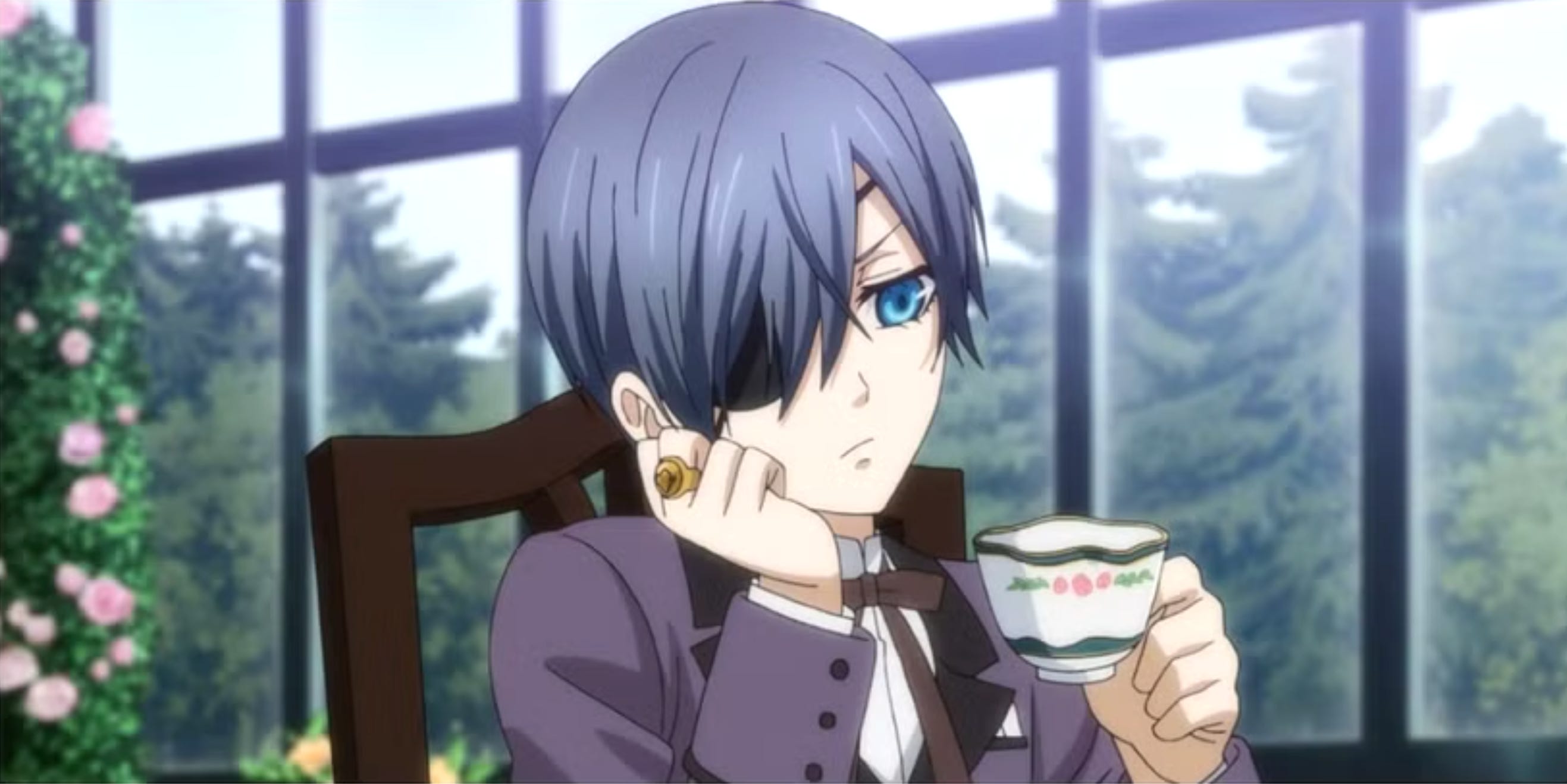
Where tea is part of Uncle Iroh’s wisdom and brings focus for L, then for Ciel Phantomhive from Black Butler, tea is something else entirely.
It is inheritance.
Ciel is the young Earl of the Phantomhive household, head of one of England’s most influential noble families and the de facto owner of the Funtom Corporation, a hugely successful toy and confectionery empire. Despite his age, he carries himself with the calculated precision of someone who has spent his entire life navigating power. Every conversation is a negotiation. Every alliance is strategic. Every smile hides another move on the chessboard.
Naturally, he drinks Earl Grey.
It almost feels too perfect, whether the creators chose Earl Grey because of its aristocratic reputation or simply because no other tea could suit him quite as well, the pairing works beautifully. Earl Grey has long been associated with British refinement, afternoon tea and upper-class society. To see Ciel holding a delicate porcelain cup is not simply to see someone enjoying tea. It is to see someone performing the role he was born into. Unlike many of the characters we’ve spoken about, Ciel doesn’t reach for tea because he needs comfort.
Tea is simply part of the architecture of his life. He grew up surrounded by silver tea services, immaculate dining etiquette and servants who understood that hospitality was another form of power. Drinking tea is no more remarkable to him than breathing. It is woven into the rhythm of being an English aristocrat. But Black Butler is never really about appearances.
Beneath the polished silver, expensive china and perfectly brewed Earl Grey sits a deeply traumatised child carrying burdens no child should ever know. The elegant tea service becomes a fascinating contradiction. Outwardly it represents civilisation, wealth and refinement. Inwardly, it masks grief, vengeance and loneliness. Tea has always been capable of doing both.
History reminds us that the elegant British afternoon tea, with its lace tablecloths and delicate porcelain, was built upon a global trade network shaped by empire, colonialism and exploitation. Beauty and brutality have often occupied the same teacup. Black Butler understands this duality instinctively.
Ciel’s Earl Grey is refined, but so is the mask he wears. Perhaps that’s why I find him such an interesting tea drinker. His cup tells us everything society wants us to see: nobility, sophistication, privilege. But it tells us almost nothing about the person underneath. And maybe that’s another lesson tea quietly offers throughout anime. A cup can reveal who we are. It can also conceal us. The tea itself never lies. But the person holding the cup sometimes does.
That, after all, is what makes Ciel Phantomhive such a compelling tea drinker. His Earl Grey is more than a favourite beverage. It is part of the costume of nobility, a symbol of inherited power and cultivated elegance. Yet every sip reminds us that even the finest porcelain can hide a cracked foundation. Tea may communicate status, but it cannot heal sorrow. Only people can do that.
Darjeeling: The Girl Who Never Spilled Her Tea
If there is one character who proves that tea can survive absolutely anything, it has to be Darjeeling from Girls und Panzer.
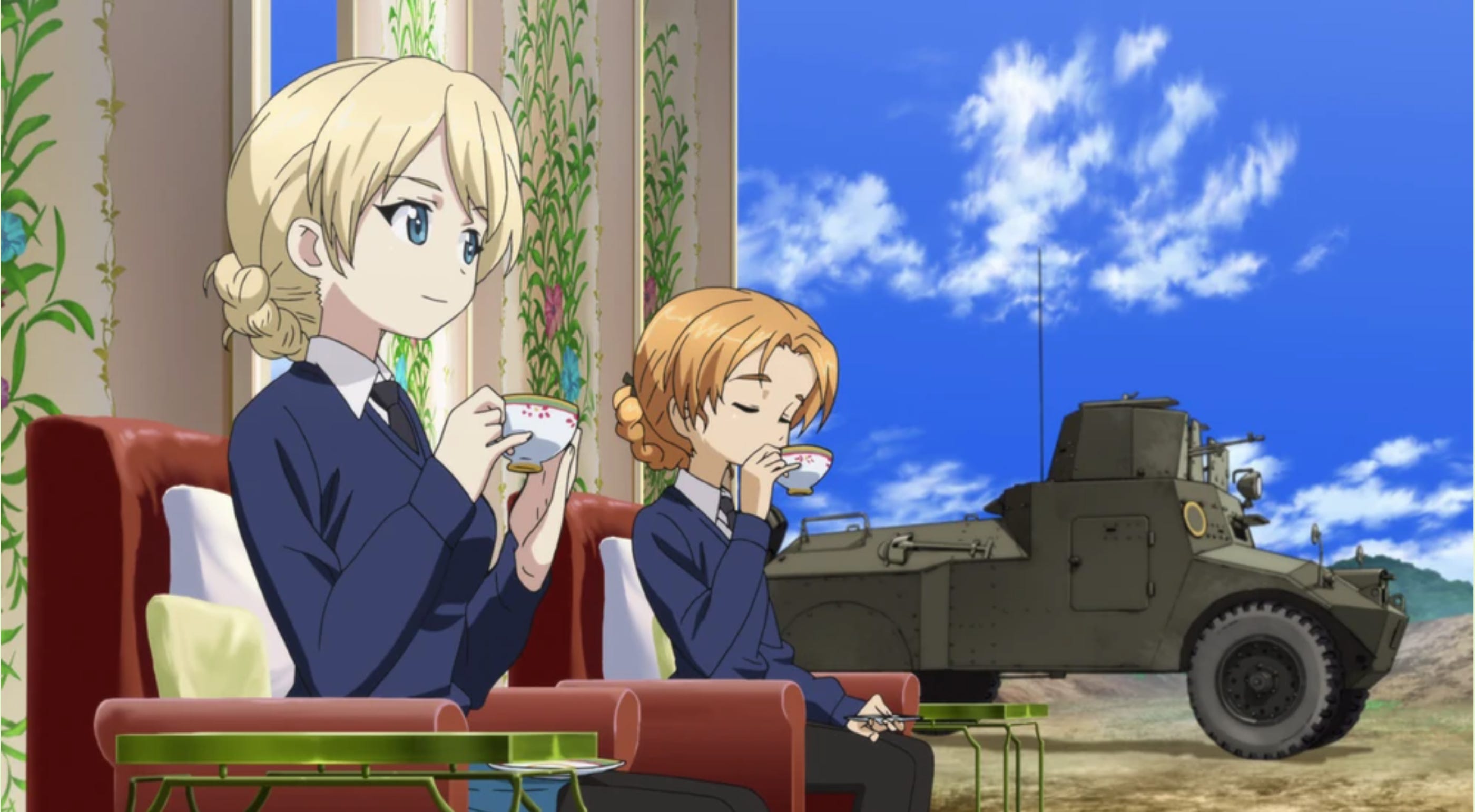
Even her name tells you everything you need to know.
She is literally named after one of the world’s most celebrated black teas, grown on the mist-covered slopes of the Himalayas in India. Often referred to as the “Champagne of Teas”, Darjeeling is prized for its delicate muscatel character, floral aroma and remarkable complexity. It is a tea that rewards patience rather than haste.
Appropriately, so does its namesake.
Darjeeling is almost never seen without a teacup in her hand, even while commanding a tank in the middle of battle.
Read that sentence again.

While shells are flying overhead, engines are roaring and armoured vehicles are attempting to eliminate one another, Darjeeling somehow finds the time to enjoy a perfectly civilised cup of tea. That alone deserves admiration.
What makes her even more memorable is that she approaches life much like a tea philosopher disguised as a military commander. Almost everything she says sounds like it belongs in a book of quotations. She frequently recites famous writers and thinkers, delivering observations with the calm confidence of someone who understands that panic has never solved a problem.
Then there is perhaps her most iconic line.
“No matter how fast we go, or no matter how many hits we take, I will never spill my tea.”
It is a wonderfully absurd statement, it is also surprisingly profound. Because when you strip away the tanks, the uniforms and the anime spectacle, what she is really talking about is composure.
Life is going to shake you.
People will disappoint you.
Plans will fall apart.
The world will speed up around you in ways you cannot control.
The question is whether you can keep hold of your tea.
I suspect that is why so many tea lovers smiled the first time they heard that line. It feels exaggerated, yet strangely familiar. Every tea drinker knows that moment when everything around you feels chaotic, but the simple act of sitting down with a cup somehow restores a sense of order. Tea has always done that.
Darjeeling simply turns it into a philosophy.
There is another detail I can’t help appreciating. Her favourite meal is fish and chips, another unmistakable nod to British tea culture. It completes the picture of a character built almost entirely from the iconography of afternoon tea, English refinement and quiet resilience. And perhaps that is the perfect place to end this journey through anime.
From Uncle Iroh’s wisdom to L’s relentless pursuit of truth. From Aizen’s unsettling composure to Gentle Criminal’s theatrical elegance. From Ciel Phantomhive’s inherited aristocracy to Darjeeling’s unshakable calm, tea appears again and again, not as a coincidence, but as a language.
Anime understands something many of us forget.
Tea is never just tea.
It can communicate wisdom without a sermon.
Discipline without force.
Elegance without arrogance.
Power without shouting.
A shared cup can reveal more about a character than an entire page of dialogue ever could. Perhaps that is why tea continues to appear across so many stories, whether it sits at the centre of the narrative or quietly waits in the background. It is one of the oldest forms of visual storytelling we have. Give a character a cup of tea, and without saying a word, we begin to understand who they are.
Or perhaps, more importantly...
...who they are trying to become.
The Tea You Almost Miss: The Eminence in Shadow
As I mentioned earlier this article did not begin as an article. It began as a question.

I was watching The Eminence in Shadow a few weeks back, this loud, deliberately absurd power-fantasy about a teenager who dies in a truck accident, gets reincarnated into a world of magic and demon cults, and proceeds to accidentally build a real secret organisation while believing the whole thing is an elaborate roleplay he invented. Was certainly not exactly the most obvious place I thought I’d find a meditation on tea culture. And yet there it was, again and again, in the background of scenes, there was a cup on a table, a tea service during a strategy briefing, steam rising while conspiracies were whispered across it.
I started thinking about all the other anime I had seen tea in. How long tea had been part of the medium. What role it was actually playing in each series. And I realised that the most interesting tea in anime is often not the tea that announces itself.
It is the tea nobody notices.
Which brings me back to The Eminence in Shadow, and why it belongs in this conversation despite having no interest whatsoever in being a tea anime.
The series has a protagonist with two identities. By day, Cid Kagenou is a deliberately forgettable student, just a background character, unremarkable by design, the kind of person whose name you would not remember five minutes after meeting him. By night, he becomes Shadow: a black-clad, red-eyed figure of theatrical omnipotence, leading a secret organisation called Shadow Garden with cryptic pronouncements that his devoted followers interpret as divine strategy. The comedy — and it is genuinely funny — is that Cid believes all of it is fiction. The cult, the enemies, the ancient demon conspiracy he invented on a whim. It is all real. He simply does not know it yet.
Tea appears in the spaces between these two identities. When Cid is performing ordinariness through attending noble gatherings, navigating academy social hierarchies, blending into polite society where tea is everywhere. He drinks it not because he enjoys it, but because not drinking it would make him memorable. He offers it because refusing to offer it would draw attention. Tea, in these scenes, is a prop in the performance of insignificance. A tool of invisibility. And invisibility, for Cid, is the highest form of power.
What is most telling to me and what the series never explicitly addresses but consistently demonstrates is that Shadow never drinks tea. The all-powerful persona has no use for social ritual. He appears, delivers his lines, performs his impossible feats, and vanishes. No pause. No shared moment. No cup. The absence is the point.
Cid has constructed a persona so complete, so overwhelming in its theatricality, that it has no room for the ordinary human rituals that sustain actual relationships. His followers, the Seven Shades, led by the elf Alpha love his image. They serve a fiction annd when they meet to plan, to strategise, to maintain the global organisation their oblivious master accidentally built, they do so over tea. They have imported the rituals of civilised society into the shadows, because tea is how you hold something together when the centre does not even know it exists.


This is, quietly, one of the most interesting observations about tea in anime I have encountered.
Because it confirms what the tea ceremony has always understood: tea is not simply a beverage. It is a social technology. A way of establishing relationship, signalling intent, and creating spaces where power can be negotiated without confrontation. Cid uses it to disappear. His followers use it to cohere. And the organisation built on devotion and ceremony outlasts every enemy built on fear and violence.
The Eminence in Shadow is not a tea anime. Its protagonist would find chanoyu bafflingly irrelevant to his goals of looking cool in the dark. But its use of tea as social camouflage, as class marker, as the absent centre of a fractured identity, that makes it one of the more revealing case studies in how anime deploys tea as narrative language. The boy who wants to be the ultimate shadow spends his days drinking tea in the light.
And never quite understands that this, too, is a kind of mastery.
Tea Was Never Just Background
After spending two years studying tea, travelling through China and before my tea sommelier training while sitting in rooms where someone was always, quietly, making something warm, I have started noticing tea in places I never expected.
Anime is one of them.
Tea isn’t there simply because Japanese people drink it. It is there because tea quietly teaches many of the same things anime is trying to teach. To be present. To respect silence. To notice beauty before it disappears. To understand that ordinary moments often become extraordinary only because someone slowed down long enough to notice them.
Tea is attention.
Tea is impermanence.
Tea is the discipline of arriving fully in the only moment that actually exists. Perhaps that is why so many unforgettable anime scenes happen over nothing more dramatic than a kettle beginning to boil. Because sometimes the most important character in the room isn’t the hero.
It’s the cup sitting quietly beside them.
If you’ve made it this far, pour yourself something warm.
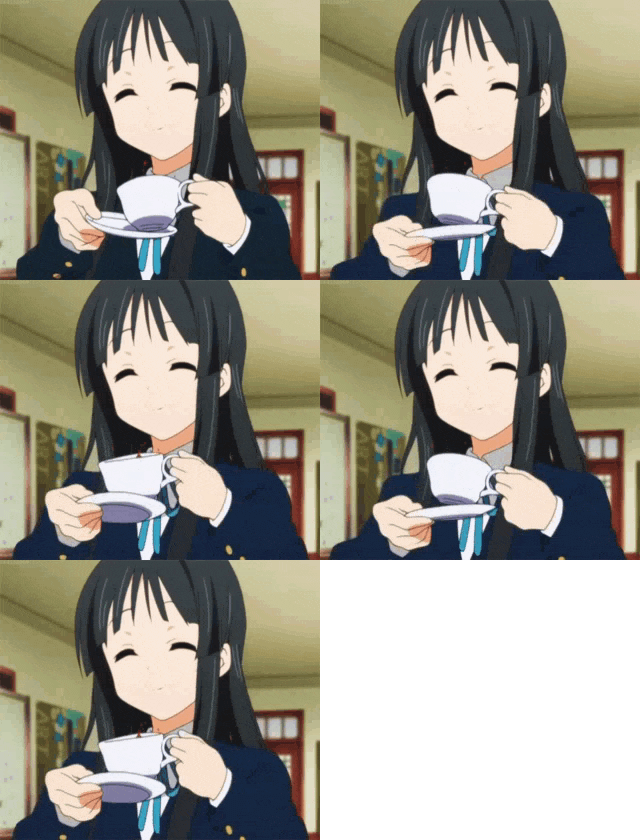
You’ve earned it.
The kettle’s boiling somewhere and someone is enjoying a warm cup of tea. 🍵
Thank you for enjoying this tea on tea in anime with me your tea loving outea.
I’d like to recommend Keabetsoe Mqwati who’s article on Death Note inspired me to finish this article, that has been almost a month in the making.
As an anime lover and tea lover, this was a really enjoyable and fun read! Thank you!
This is a well-thought-out article! That Darjeeling quote is staying with me - “I will never spill my tea.” Perfect way to put calm in chaos into words.